


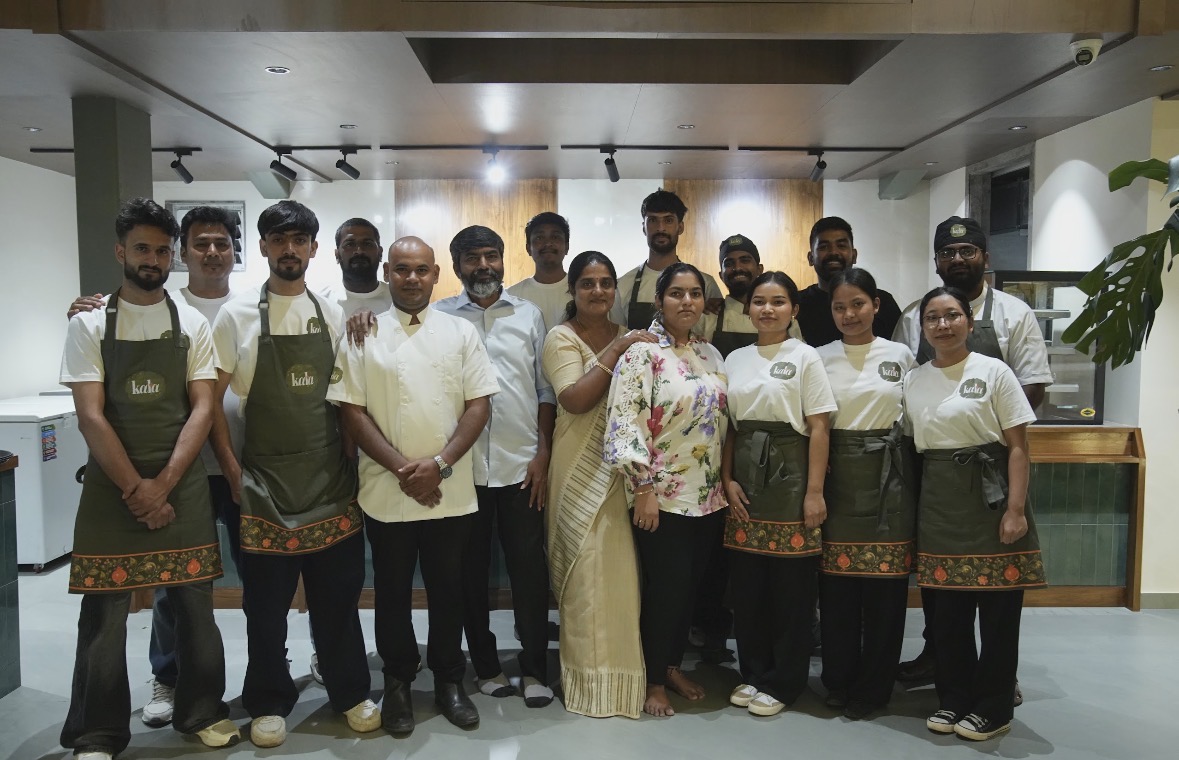
A café menu usually begins in the kitchen. At Kala Café in Hyderabad’s Kokapet, it began with a mother’s question; what was her daughter eating? That concern set co-founder, Hema Sushmitha on a farming journey that has grown into a 350-acre operation, over 300 native breed cows and the retail brand Pernati Naturals.

“I wanted to feed my daughter good and natural food,” said Sushmitha, who began with a single cow to secure milk she could trust. A kitchen garden followed, then vegetables, pulses, groundnuts and paddy. What started as a family’s food supply gradually evolved into a larger farming enterprise.
The journey came with its share of setbacks. Sushmitha recalled how her husband and co-founder, Pernati Syam Prasad Reddy, encouraged her to persist through difficult seasons. “Even if there is profit or loss, continue with it. Don’t come back,” he would tell her.
Today, she oversees cultivation, production and processing, while Reddy manages the business. “Business is like maths for me, and production is like a cakewalk,” she smiled and said.

Finding a market that offered fair returns for her produce proved to be a challenge. Pernati Naturals emerged as a way to bridge that gap by taking the farm’s produce directly to consumers. Today, around 80% of the products on its store shelves come from the family’s own farms located in Nellore. “We source less and grow more,” said Reddy.
The business brought another insight. Customers liked the produce but lacked the time to cook with it. “They told us, Your products are good, but we don’t have time to cook. Why don’t you start a café using your own products?” Sushmitha recalled. Kala Café grew from that suggestion, bringing the farm’s ingredients from the store shelf to the plate.
Not the usual café
At Kala Café, natural ingredients do not come with a side of dietary sermons. The menu is as comfortable with Fried Prawns and Chicken Croquettes as it is with quinoa, pumpkin and millets. The idea is to make thoughtfully sourced food part of everyday café dining, rather than confining it to the predictable territory of salads and steamed vegetables.

The menu brings regional ingredients into familiar café formats. The Gongura Melt, for instance, pairs sautéed gongura and gongura pickle with mozzarella, cashew podi and sourdough bread. Sweet Potato Fries get a local flourish with Andhra gunpowder, served alongside peri peri mayonnaise. Black chana is reimagined as hummus, accompanied by a stir-fry with garlic oil and sesame lavash.
There are more playful combinations, too. The Quinoa Pumpkin Salad brings together quinoa prepared two ways, roasted pumpkin, pumpkin seeds, arugula, feta, charred cherry tomatoes, orange segments and a green chilli vinaigrette. Country Chicken Croquettes are served with tzatziki, arugula and tomato chutney, while Shrimp Popcorn comes with peri peri chilli lime mayonnaise. For a more substantial meal, Congee & Curry combines garlic congee with a choice of lamb or yam curry, fennel salad, flatbread and pickled radish.

The menu is not trying to make every dish look or sound virtuous. Instead, it uses ingredients such as gongura, cashew podi, jaggery and sesame to bring a distinct local character to recognisable café fare.
Natural, without the lecture
For Chef Shantanu Kathakam, Head of Operations at Kala Café and the chef behind its menu , the distinction lies in how the ingredients are sourced and handled, not in whether a dish fits a narrow definition of healthy food.
“Natural food does not have to mean vegetarian food or a menu built around salads. You can serve fried chicken or shrimp and still be particular about the quality and source of your ingredients,” he said.

That philosophy extends to the kitchen’s preparations. Sauces, mayo, condiments and sweet elements are made in-house using ingredients such as peanuts, sesame, banana, honey and jaggery. Rather than relying entirely on ready-made additions, the team works with flavours that complement the produce and give familiar dishes a more individual identity.
The drinks follow a similar approach. The Jaggery Sea Salt Latte combines espresso and milk with Pernati jaggery and a touch of sea salt, while the Banana Bread Latte draws on caramelised banana and cinnamon. The Sesame Caramel Latte offers a nuttier, slightly savoury note, and the Coconut Cream Cold Coffee gives a familiar café favourite a softer finish.
The objective is not to make every ingredient an announcement. It is to let natural flavours do the work, whether in a savoury dish or a cup of coffee.
Quality comes at a cost
At Kala Café, the farm-to-table promise extends beyond the ingredients grown on the family’s own fields. Around 80% of the produce used by the café comes from Pernati Naturals’ farms. The remaining 20% is sourced from outside, but the founders are particular about how these ingredients are grown. They want them to meet the same standards as the produce from their own farms.
The guiding principle of the family-run business is pretty simple; “If we wouldn’t feed it to our own family, we wouldn’t serve it to yours.”

That commitment, however, comes at a price. Chef Shantanu informed that the café uses the family’s own wood-pressed oil, which costs between INR 720 and INR 1,000 a litre for frying, compared with around INR 200 for conventional oil. For the founders, the difference is worth paying if it means staying true to the quality they want on the plate.
Expansion plans
With Kala Café investing around INR 4–4.2 crore in its Hyderabad venture, the family is now looking to expand Pernati Naturals’ retail footprint and food business. A new Pernati Naturals store in Jubilee Hills is expected to open in December, with three additional stores planned in Hyderabad. Mumbai, Goa and Bengaluru are also on the expansion map, although the investment outlay and timelines for these locations are yet to be specified. The family is also planning a separate restaurant concept centred on traditional Telugu cuisine, with the aim of using ingredients sourced through Pernati Naturals.
The founders intend to scale the business in step with farm production, bringing more farmers into the supply network as demand grows. A franchise model is also being considered for the future.
Asmita.mukherjee@saffronsynergies.in