


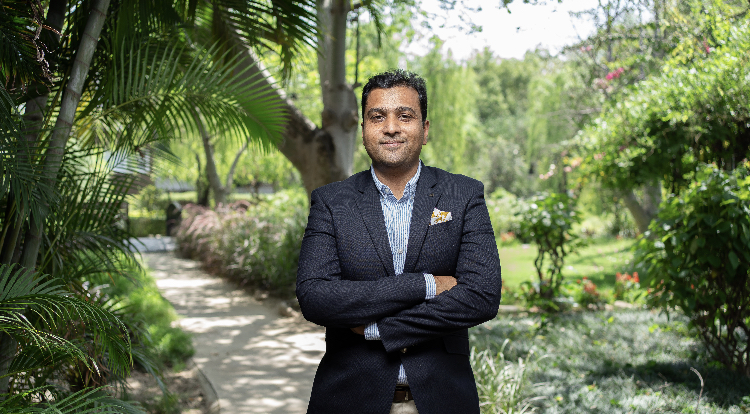
Anirudh Lakhotia, director of Ivory Destinations, which owns and operates two boutique resorts in the highly sensitive ecosystems of Uttarakhand – Corbett and Mukteshwar – talks about how they try to conduct business differently because of their family’s attachments and deep roots in the region.
After 13 years of operating their flagship resort – The Golden Tusk – in Corbett, Ivory Destinations had expanded to Mukteshwar early this year, opening The Chamomile Estate, an all of 7 suites resort in a 2.5 acre land tucked away from the mainstream inside a tea-growing village. As in The Golden Tusk, a nomenclature that connects directly with the nature and wildlife of Corbett, in Mukteshwar the name was also a conscious choice as it represents the Chamomile flowers unique to the place.
“The sense of place is quite critical for us as we belong to the region and have deep roots here,” said Lakhotia, who drive the family business, which is into multiple other areas like horticulture, poultry and dairying. “Our family has been based out of this town called Ramnagar for generations now, about over a hundred years,” Lakhotia says, adding that the feeling of being from the landscape itself creates a deeper instinct to protect it. “Somewhere you feel that sense of belongingness and that sense of responsibility towards the place,” he added.
The Golden Tusk, which began 13 years ago as a greenfield project he helped build from scratch, sits on 10 acres in the southern periphery of the Corbett National Park and has grown into a spread-out resort of 64 suites and villas. Lakhotia says the family always had an emotional thread linking them to hospitality; his grandfather had once started Hotel Tiger in the 1970s in Ramnagar.
The Chamomile Estate was conceived during pandemic and the idea was inspired by pandemic-era travel patterns, where people craved privacy, smaller settings and homestay-like comfort, but with the reliability of a professional resort. “We wanted to marry a fully serviced resort and a B&B sort of a property; give the conveniences that one seeks in a B&B, but at the same time make it hassle-free,” he says. The villa-style structure with seven rooms under one roof was designed to allow both togetherness and privacy.
The resort evokes the solitude of old hill holidays, a contrast to the crowded, construction-heavy hill circuits. “The village is a tea-growing village. When I saw the site, there was a lot of chamomile flowers growing wild there,” he says, and therefore the resort had to carry that sense of place. Just as The Golden Tusk captures Corbett’s wildlife energy without overusing the destination’s name, The Chamomile Estate is rooted in its local landscape. “The name must tell a story about the place that you’re in,” he said narrating the brand ethos.
Lakhotia feels that being from the region they are able to “identify the red flags” on ecology and environment faster than others. Citing few incidents involving his own guests in the past, Lakhotia said that they try their best to communicate with the guests the do’s and don’ts while in the resort or outside in the forest area, which they needed to comply with strictly.
“Corbett turning into a wedding destination is worrisome,” he said sharing the concerns of the local entrepreneurs. “The way to enter the market is very simple,” he said. A lot of people who have built holiday homes in the hills have converted them to home stays and boutique accommodations listing them with online platforms like Airbnb.
For Lakhotia, the evolution from The Golden Tusk to The Chamomile Estate is not just about adding inventory or a destination to their portfolio, but about ensuring that each new property mirrors the character of its location while keeping environmental conscience at the core. Both resorts, he says, are tied to the land they stand on—one shaped by Corbett’s forests and decades of family history, the other by quiet tea gardens and wild chamomile—and for a family that has lived in Ramnagar for more than a century, hospitality cannot be detached from responsibility.