


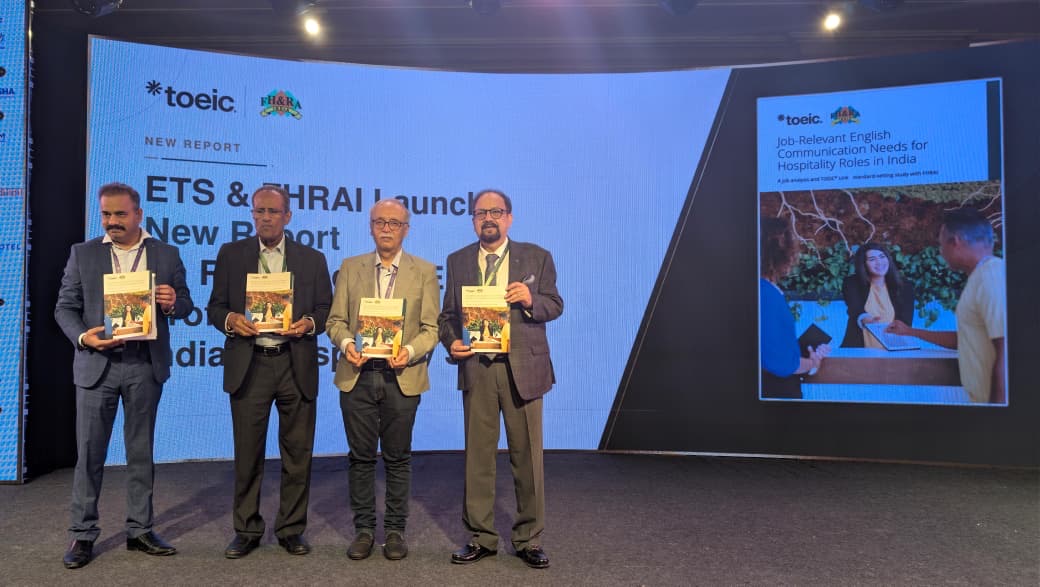
English proficiency requirements in India’s hospitality sector are driven more by job responsibilities than seniority, according to a new study by ETS (TOEIC programme) and the Federation of Hotel and Restaurant Associations of India (FHRAI).
Launched at the 56th FHRAI Annual Convention in Varanasi, the report, Job-Relevant English Communication Needs for Hospitality Roles in India, establishes role-specific English proficiency benchmarks for six positions across Front Office, Food & Beverage and Housekeeping.
The study found that some junior, guest-facing employees require stronger English skills than senior colleagues in more internally focused roles. Junior housekeepers, for instance, require higher Listening, Reading and Speaking proficiency than senior housekeepers, reflecting their greater direct interaction with guests.
In Front Office and Food & Beverage, however, senior roles showed higher writing requirements, linked to responsibilities such as policy documentation and occupancy reporting. Speaking emerged as a key requirement across guest-facing positions, particularly for handling guest requests, complaints and real-time interactions.
Food & Beverage roles recorded the most complex communication requirements, spanning guest service, staff supervision and client interactions.
Surendra Kumar Jaiswal, President, FHRAI, said the findings provide the industry with a common reference point for developing hiring criteria, training programmes and career-development frameworks based on the actual communication requirements of individual roles rather than job titles.
The study involved 27 hospitality subject matter experts, with an average of 21 years of industry experience, who evaluated the English-language tasks required across the six roles. Their findings were further validated using TOEIC Link scores from 331 hospitality employees working in the roles studied.
Ratnesh Jha, Global General Manager, Institutional Products, ETS, said the benchmarks could help hospitality organisations align recruitment and training decisions with the actual language demands of individual positions.
Ajay Pratap Singh, Regional Director – South Asia, ETS (TOEIC), said the research translates the sector’s communication requirements into precise, role-specific English standards by combining FHRAI’s industry expertise with TOEIC’s language assessment capabilities.
The study recommends that hotels incorporate role-specific English expectations into job descriptions, recruitment assessments, interviews and training curricula, enabling organisations to match language capability with the operational and guest-service demands of each position.