


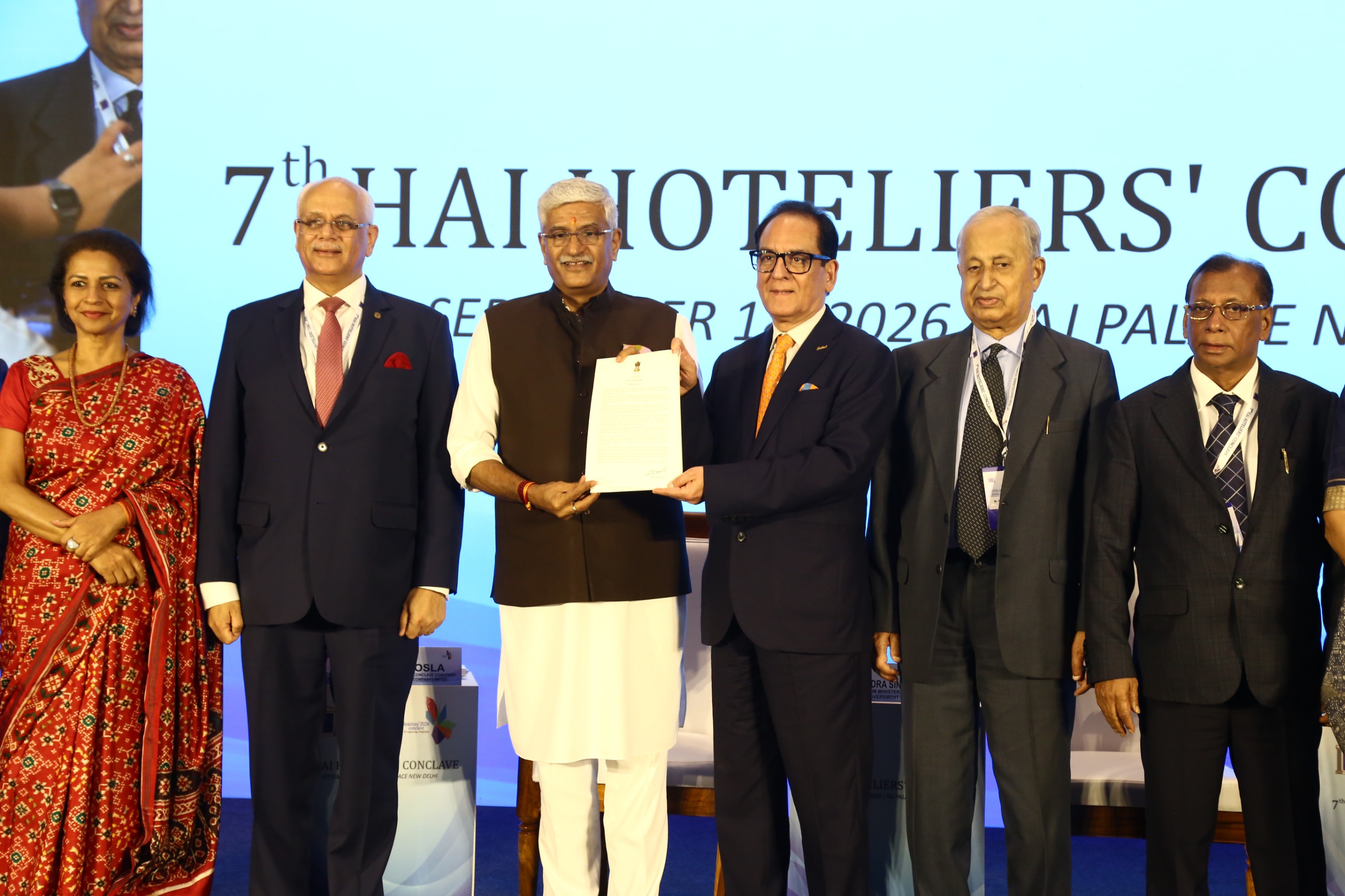
The Hotel Association of India (HAI) has called for structural reforms, infrastructure status and greater ease of doing business to enable the hospitality sector to play a larger role in India’s tourism and economic growth agenda towards 2047.
The association made the case at the 7th HAI Hoteliers’ Conclave, held at Taj Palace, New Delhi, on September 18, under the theme ‘Re-Engineering Hospitality’. The conclave was inaugurated by Union Minister for Tourism and Culture Gajendra Singh Shekhawat and brought together policymakers, tourism authorities, hospitality companies and industry stakeholders.
The discussions focused on investment, infrastructure, employment, destination development, technology, sustainability, MICE and policy reforms, with HAI highlighting the need to move from policy intent to measurable execution.
Shekhawat said India’s hospitality sector is moving beyond accommodation towards experience-led tourism. “With over 400 crore domestic tourist visits in 2024 and a growing middle class increasingly prioritising travel and experiences, India has immense potential to drive tourism-led growth,” he said.
He added that India’s cultural heritage, technology and expanding infrastructure could shape the next phase of tourism, but realising this potential would require “scale, speed, confidence and transformation”.
HAI President and Chairman – South Asia, Radisson Hotel Group, KB Kachru said the sector needs policy, investment, execution and talent reforms to support its expansion.
“Re-engineering hospitality must go beyond how we operate—it must reshape how we approach policy, investment, execution and talent,” Kachru said. With around 225,000 hotel rooms in the country, he said hospitality has the potential to create jobs, attract investment, generate foreign exchange and drive economic growth.
He called for stronger infrastructure, connectivity and destination-level delivery, alongside measures to improve India’s competitiveness in global tourism, MICE and weddings.
Former G20 Sherpa of India and former NITI Aayog CEO Amitabh Kant said destination development, global branding and last-mile infrastructure would be critical to unlocking tourism’s economic potential.
“India’s tourism opportunity is immense, but unlocking it requires a renewed focus on global branding, job creation and destination development,” Kant said. He also highlighted the need to strengthen roads, connectivity, cleanliness and basic services, while improving destination management and administrative accountability.
MP Bezbaruah, Secretary General, HAI and former Secretary, Ministry of Tourism, said expanding capacity, strengthening the tourism ecosystem and creating an environment conducive to long-term investment would be key to harnessing the sector’s global potential.
The conclave also featured a plenary session, ‘Incredible India: Invaluable Economics’, with Puneet Chhatwal, Chairman, FAITH and Managing Director & CEO, The Indian Hotels Company Limited. The session examined the economic contribution of tourism and hospitality and the sector’s potential role in India’s broader growth agenda.
A fireside chat with senior journalist Rajdeep Sardesai and former Indian cricketer Kapil Dev explored leadership, resilience and lessons from sport relevant to the hospitality industry.
The conclave also examined talent and inclusion, tourism and MICE, AI and technology, sustainability, food and beverage and India’s positioning as a global hospitality and tourism destination.
Suman Billa, IAS, Additional Secretary & Director General (Tourism), Government of India, and Bhuvnesh Kumar, IAS, Secretary (Tourism), Government of India, shared perspectives on ‘Unlocking the Potential of Indian Hospitality for a Viksit Bharat 2047’.
The event, attended by more than 300 representatives from hotel companies, industry associations and allied sectors, concluded with a renewed emphasis on government-industry collaboration, investment readiness, destination development and policy execution as India works towards its 2047 tourism ambitions.