


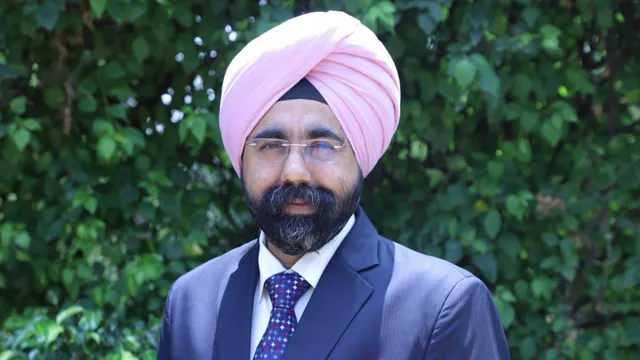
With travellers becoming more discerning and competition intensifying, hotels are increasingly focusing on guest loyalty and operational consistency to drive long-term growth. Deep Mohan Singh Arneja, General Manager, Courtyard by Marriott Agra, believes sustained success depends on operational discipline, pricing integrity and consistent guest experiences rather than short-term revenue gains. Speaking to Asmita Mukherjee, he said that while Agra benefits from strong tourist demand, maintaining a hotel’s reputation requires a clear strategy and flawless execution.
Beyond occupancy
Arneja noted that while peak travel periods naturally support occupancy levels, the true test of a hotel’s resilience emerges during shoulder seasons. “Agra is often described as a destination with guaranteed demand, but anyone who has worked here long enough knows that demand alone does not build a hotel’s reputation—how you manage that demand does,” he said.
According to him, modern travellers arrive better informed, have higher expectations and are more conscious of value than ever before. As a result, occupancy is no longer simply about filling rooms but about maintaining relevance in an increasingly competitive market.
Reflecting on the property’s recent upgrades, Arneja said the hotel deliberately chose a measured approach rather than overstretching operations to maximise short-term revenue. “At times, we have chosen to slow down rather than stretch operations. I’ve learnt—both through experience and observation—that a hotel’s reputation behaves much like trust. It is accumulated quietly and lost very publicly,” he stated.
Emphasising the importance of guest experience over volume, he added, “A full house impresses for a night. A remembered stay carries the brand forward.”
RevPAR with context
While revenue management remains a critical focus area across the industry, Arneja cautioned against viewing RevPAR as a standalone indicator of success.
“RevPAR is important—there is no debate there. But it is also one of the most misunderstood metrics when isolated from context. Strong RevPAR does not come from constant intervention; it comes from clarity of positioning and confidence in one’s product,” he explained.
Drawing from his experiences across various markets, he observed that some of the world’s most respected hotels distinguish themselves through consistency rather than constant reinvention.
“In some of the most respected properties I’ve experienced, the focus was not on daily excitement but on daily reliability. They were not trying to surprise the guest every morning—only to make sure they never disappointed them,” he said.
Arneja further stressed the importance of maintaining pricing integrity, particularly during renovation and refurbishment cycles.
“Discounting is easy; recovering credibility is not. Especially during refurbishment phases, we remain honest about what we can deliver and price accordingly,” he said.
Quoting a principle that has influenced his commercial philosophy, he added, “The most important thing about business is business. For me, that means emotion belongs in service, not in commercial decisions.”
Driving ancillary revenue
With hotels increasingly relying on ancillary revenue streams to strengthen profitability, Arneja believes success lies in creating opportunities rather than aggressively selling products and services. “Ancillary revenue has become central to hotel profitability, but pushing it rarely works. The more refined approach is to design opportunity, not pressure spend,” he said.
At Courtyard by Marriott Agra, food and beverage operations have benefited from focusing on authenticity and local relevance rather than chasing temporary trends.
“Food and beverage performs best when it reflects a sense of place and confidence rather than trend-chasing,” he noted.
The hotel has also witnessed steady growth in social gatherings and smaller events, driven largely by guest confidence in execution and service delivery. “Guests spend more when they feel understood, not when they feel persuaded. When hospitality becomes intuitive, revenue follows naturally,” Arneja said.
Evolving guest expectations
The changing profile of the modern traveller is another area that Arneja believes hoteliers must continuously adapt to.
“Today’s guest, domestic or international, is far more aware than before. They notice details, question inconsistencies, and form opinions quickly,” he observed.
At the same time, he noted that travellers increasingly seek simplicity and seamless experiences. “They seek effortless check-ins, familiar warmth, and genuine human interaction,” he said.
Long-stay guests, in particular, have emerged as valuable sources of insight and advocacy. “When engaged well, they offer more honest feedback than surveys ever will. Over time, they also become ambassadors—quietly, credibly, and far more effectively than marketing campaigns,” Arneja explained.
Highlighting the importance of guest loyalty, he added, “The strongest brand voices are guests who return even when they don’t have to.”
Consistency as a differentiator
As Agra continues to attract both international tourists and domestic leisure travellers, Arneja believes many hotels risk diluting their identity by attempting to cater to every segment simultaneously. “The temptation is always to over-serve—add more, promise more, stretch more. I’ve come to believe the opposite,” he said.
According to him, successful hotels differentiate themselves through focus and consistency rather than complexity. “Distinct hotels are not built by doing everything; they are built by doing the right few things consistently,” Arneja stated.
He pointed out that different traveller segments seek different outcomes, whether experiences, comfort or assurance but delivering consistently on core promises remains the key differentiator. “Consistency is the quietest form of confidence,” he remarked.
Talent challenge
Like many hospitality leaders across the country, Arneja identified talent attraction and retention as one of the industry’s most pressing concerns. “If there is one uphill task in hospitality today, it is people. Talent attraction and retention are genuine industry challenges—but they cannot be solved by policy alone,” he said.
He believes organisational culture plays a far more important role in retaining talent than rules or processes. “People don’t stay because of rules; they stay because of environments,” he noted.
At Courtyard by Marriott Agra, the focus has been on building a culture centred around continuous learning, empowerment and trust. “Training is continuous, empowerment is real, and control mechanisms exist to support—not suffocate—performance,” Arneja explained.
While leadership visibility remains important, he stressed that culture ultimately shapes guest experiences. “A well-trained team performs. A well-trusted team protects the guest experience when no one is watching,” he added.
Long-term value creation
Summing up his philosophy, Arneja described hotels as more than physical assets or commercial enterprises. “At the end of the day, hotels are not just assets—they are promises,” he said.
According to him, long-term success comes when service, food and beverage, infrastructure and people operate with a shared purpose. “A desirable product is built when space, service, food, and people move in the same direction. That alignment requires patience, discipline, and belief,” he stated.
As hospitality businesses navigate a rapidly evolving operating environment, Arneja believes the fundamentals remain unchanged. Hotels that focus on trust, consistency and authentic guest experiences will ultimately build stronger brands and more resilient businesses. “The journey is not always smooth, but when done right, the hotel stops chasing demand—and demand starts returning on its own,” he concluded.