


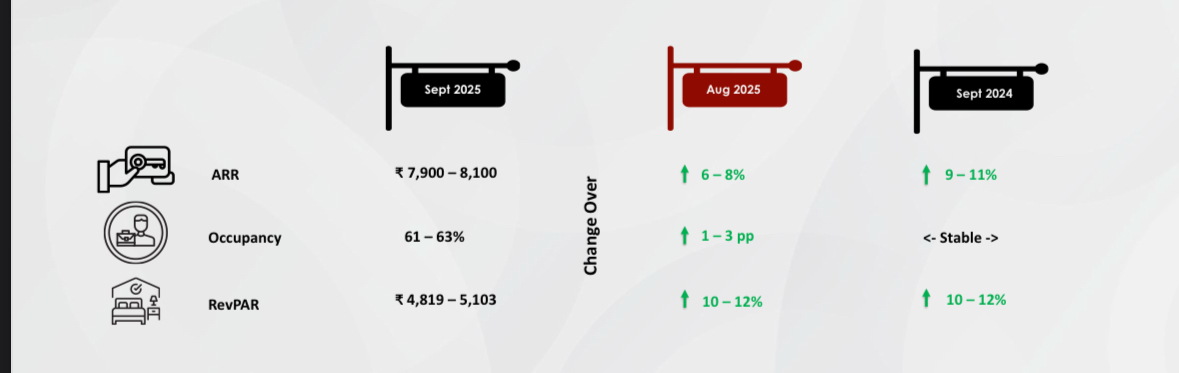
India’s hospitality industry continued its steady run through September 2025, recording healthy growth in room rates and stable occupancies despite the seasonal slowdown typically seen during the monsoon months. The latest HVS ANAROCK Hospitality Monitor reports that the sector sustained its post-pandemic momentum, driven largely by strong corporate travel and MICE activity.
Average Room Rates (ARR) during September ranged between INR 7,900 and INR 8,100, while occupancy levels held firm at 61 to 63 percent. This translated into a RevPAR between INR 4,819 and INR 5,103, underscoring the resilience of the hotel industry as business travel continues to fuel demand across key metropolitan markets.
Among individual cities, Bengaluru and Hyderabad emerged as the strongest performers, registering year-on-year ARR growth of 25 to 27 percent and 21 to 23 percent, respectively. Leisure destination Goa, however, witnessed a dip in average rates following a busy holiday season earlier in the year, while other markets recorded moderate growth between zero and 20 percent.
In occupancy terms, Ahmedabad led the charts with an increase of 10 to 12 percentage points compared to the same period last year, supported by a surge in trade exhibitions, expos, and corporate events. Cities such as Chandigarh, Gurugram, and Mumbai also recorded occupancy improvements ranging from three to twelve percentage points, reflecting the continued recovery of business and leisure segments alike.
The branded hotel market in India also saw significant activity. By September 2025, there were 308 branded hotel signings, accounting for 38,806 keys nationwide. Tier-I cities remained the focus of developer interest, representing a 28.1 percent year-on-year increase in new signings. During the same period, 120 branded hotels opened in Tier-I markets, adding 9,219 keys to the country’s organized supply.
On the financial front, listed hospitality companies reflected a mixed performance on the stock market as of October 28, 2025. Indian Hotels Company Limited maintained its leadership position with a market capitalization of INR 105,554.6 crore, its share price rising 3.1 percent to INR 746.5. ITC Hotels Limited recorded a 4.9 percent decline, while Ventive Hospitality Limited and Schloss Bangalore Limited saw increases of 4.6 and 5.1 percent, respectively, highlighting investor optimism in select hospitality counters.
Supporting this steady sectoral performance, India’s domestic aviation market continued to expand, with 110.7 million passengers traveling between January and August 2025—a 4.99 percent increase over the same period last year. The rise in air traffic has bolstered demand for hotels across business and leisure destinations, particularly in high-connectivity corridors.
Quarter-on-quarter performance saw a marginal dip, reflecting seasonal trends rather than structural weakness. During the third quarter of 2025, the sector recorded an ARR of INR 7,500 to INR 7,700, occupancy levels of 60 to 62 percent, and a RevPAR in the range of INR 4,500 to INR 4,774. Major markets such as New Delhi, Mumbai, Bengaluru, and Chennai witnessed ARR growth between 1 and 9 percent compared to Q3 2024, while Ahmedabad and Goa posted occupancy gains of 5 to 12 percentage points, indicating solid underlying demand.
The quarter also brought a series of strategic brand launches and corporate developments within the hospitality sector. ITC Hotels introduced its new premium brand, Epiq Collection, signaling a move toward an asset-light model. The food and beverage industry is meanwhile gearing up for an estimated INR 9,000 crore IPO pipeline, reflecting renewed investor confidence in India’s consumption-driven growth story. Chalet Hotels launched ATHIVA, a new premium lifestyle brand, expanding its presence in the upscale urban hospitality segment. In the country’s northeast, branded room inventory is expected to double by 2030, supported by improved infrastructure and rising tourist arrivals. Interestingly, the first half of 2025 also saw smaller cities leading India’s Greenfield hotel projects, demonstrating growing potential beyond traditional metro hubs.
Despite a mild seasonal slowdown, the Indian hotel sector continues to demonstrate strength, with balanced growth across both pricing and occupancy metrics. With domestic travel demand holding firm and new brands entering the market, the industry’s outlook for 2026 remains positive—anchored in strong fundamentals, investor confidence, and expanding regional diversity.