


Rethinking the Bigger-is-Better Approach
A long-held assumption in India’s hotel development landscape is now being challenged: bigger rooms do not necessarily translate into better financial performance. According to analysis by Hotelivate, the industry’sindustry’s tendency to build oversized guestrooms may be doing more harm than good.
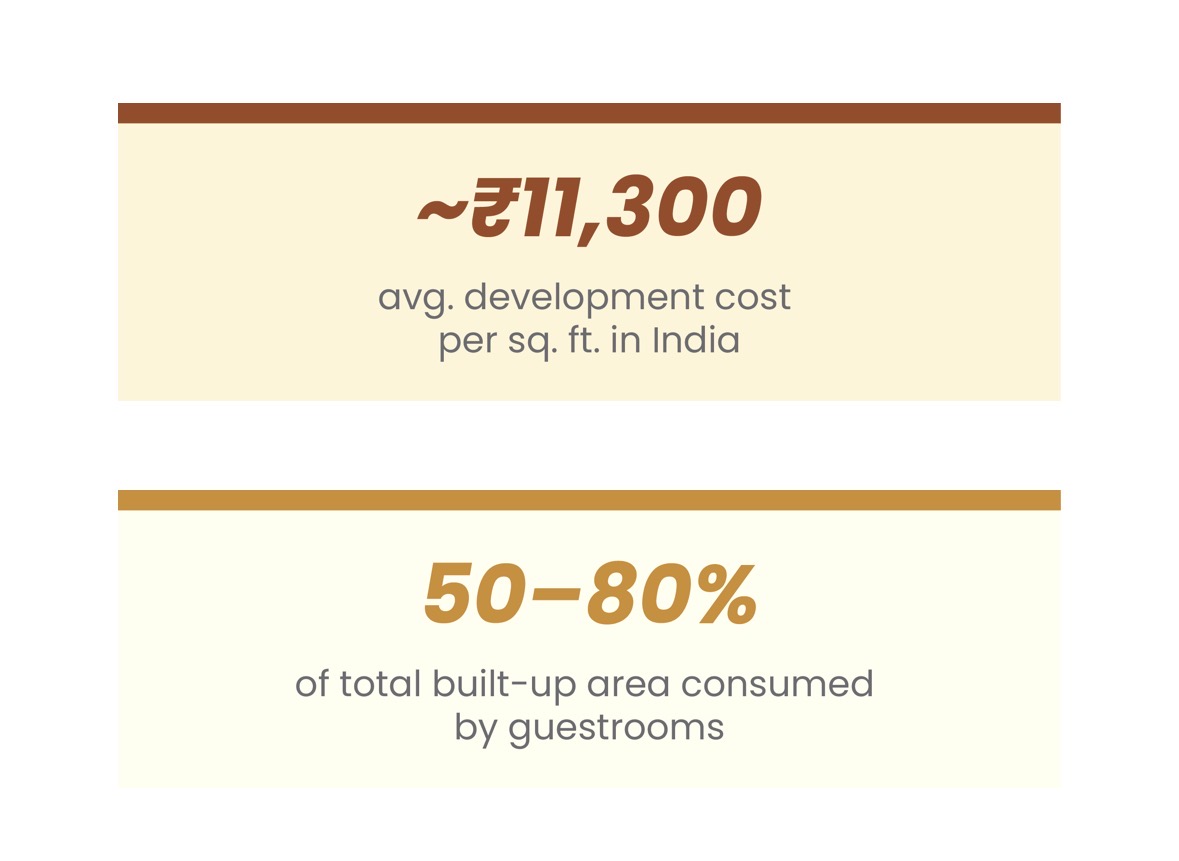
With development costs averaging ₹11,300 per sq. ft., increasing room sizes without clear returns is emerging as a critical concern for developers and investors alike.
The Data Questions Conventional Wisdom
Hotelivate’s analysis of branded hotel performance across India for 2024/25 reveals a consistent pattern—room size has limited correlation with RevPAR.
At a national level, aggregated data may suggest a positive relationship between larger rooms and higher revenue. However, once broken down by market segments, geographies and hotel types, this correlation largely disappears.
Urban Hotels Show Minimal Gains
In urban markets, which account for over half the sample, hotels with room sizes between 35 m² and 45 m² deliver nearly identical RevPAR performance.
This effectively means that a significant increase in room size—up to 30%—does not yield a meaningful financial advantage, raising questions about the capital efficiency of larger formats.
Leisure Segment Reveals a Reverse Trend
The findings are even more striking in leisure destinations. Hotels with room sizes between 45 m² and 50 m² outperform those with rooms exceeding 50 m².
In this segment, increasing room size not only fails to improve returns but is associated with lower, indicating that overbuilding can actively dilute performance.
Regional Trends Reinforce the Pattern
Across India’s regions, the data continues to point in the same direction. In the East, South and West, mid-sized rooms outperform larger ones, while in the North, a wide variation in room sizes produces almost no difference in revenue performance.
Even in markets where larger rooms might be expected to command a premium, the financial upside remains limited.
Hotel Size and Inventory Dynamics
When analysed by hotel inventory, the pattern persists. Properties with 100–149 keys show no RevPAR advantage across a wide room size range, while larger hotels with 150+ keys demonstrate stable performance within more compact room formats.
In several cases, performance declines as room sizes increase, highlighting inefficiencies at scale.
Tier 2 and Tier 3 Markets Face Higher Risk
The risks of overbuilding are particularly pronounced in Tier 2 and Tier 3 cities. Here, hotels with rooms sized between 45 m² and 50 m² perform on par with—or better than—those with larger configurations.
For developers in these markets, over-specification can significantly impact project viability and long-term returns.
Identifying the Real Performance Drivers
The analysis underscores that room size is not the primary driver of hotel success. Instead, performance is shaped by a combination of more fundamental factors.
Location remains the most critical determinant, followed by brand strength and distribution reach. Hotels that are aligned with their target market and offer a well-defined product-market fit consistently outperform those built on generic assumptions.
Over time, intangible factors such as character, legacy and guest experience also play a defining role in sustaining performance.
A Shift Towards Smarter Development
India’s hotel pipeline continues to expand rapidly, with over 120,000 rooms planned. While this growth signals opportunity, it also raises concerns about capital allocation and design efficiency.
The evidence suggests that beyond a certain threshold, increasing room size adds cost without delivering proportional value. For developers, the focus is shifting from building larger assets to building smarter ones.
Build Right, Not Bigger
The takeaway for the industry is clear: disciplined, data-driven development will define the next phase of hospitality growth in India.
Optimising room size to align with market realities—rather than assumptions—can unlock better returns and more sustainable project outcomes. In an increasingly competitive landscape, success will depend less on scale and more on precision.
Right-sizing, rather than oversizing, is emerging as the new benchmark for performance-driven hotel development.