


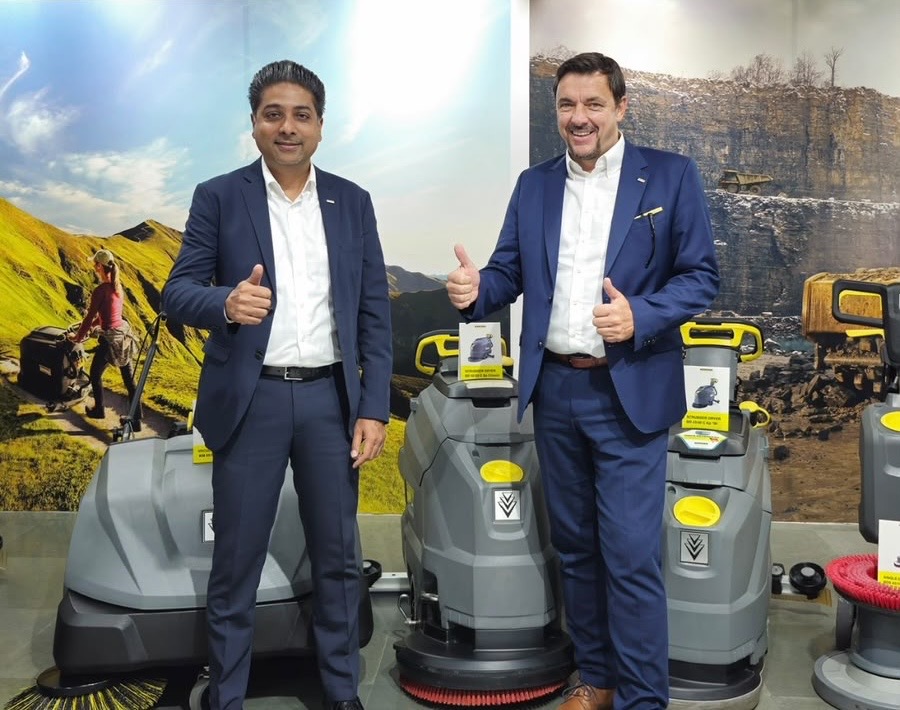
German cleaning technology major Kärcher is stepping up its localisation strategy in India, with the company aiming to increase the share of locally manufactured machines and detergents from the current 15% to at least 40% by 2030. The move is expected to strengthen its ability to offer cleaning solutions tailored to the requirements of the Indian market, particularly the fast-growing industries like hospitality, healthcare, pharmaceuticals, food processing, etc.
The company recently unveiled its first batch of professional cleaning equipment manufactured locally at its facility in Coimbatore, set up under its wholly owned subsidiary, Kärcher Technology India. The company had acquired a supplier space in Coimbatore around two years ago as part of its efforts to establish a stronger local manufacturing base.
The locally manufactured professional cleaning portfolio included scrubber dryers, single-disc machines for deep floor scrubbing, buffing and polishing, vacuum sweepers, ride-on scrubber dryers, cold-water high-pressure cleaners and manual push sweepers.
According to Markus Limberger, COO, Alfred Kärcher SE & Co. KG, the objective of increasing local production is not only to reduce the logistical footprint but also to bring the company closer to its customers.
“As of this year, we are at about 15% localisation. Our ambition is by 2030, we need to be close to 40%,” Limberger said, clarifying that the target covers machines as well as detergents used along with the equipment.
Limberger said that the company expects the localisation level to vary by product, with certain categories having the potential to move towards near-complete local production. Wet and dry vacuum cleaners, steam cleaners and pressure washers are among the products being targeted for localisation, driven by what the company sees as strong and growing demand in India, he said.
The strategy will also progressively extend to local sourcing of spares, wherever feasible.
A key benefit of local production, according to Limberger, will be the reduction in transportation and logistics costs. While the company did not put a specific figure on the potential reduction in consumer prices, he said a part of the savings would be passed on to customers.
“Part of it will be transferred to customers, and part of it we will be used to drive innovation,” he said.
The longer-term objective, he added, is to make the Indian subsidiary increasingly autonomous, with greater responsibility for product development, sourcing and production within the country.
“The idea is to make it fully autonomous,” Limberger said. “At the end of the day, India will also define the products that are developed in India, produced in India, and sourced in India.”
While German engineering expertise will continue to form the foundation of Kärcher’s technology, the increased local autonomy is expected to allow products to be adapted more closely to Indian requirements.
For Kärcher India, the localisation drive comes at a time when mechanised cleaning is gaining ground across industries. Prashant Srirangam, Senior Director – India Region, Alfred Kärcher SE & Co., said the market for mechanised cleaning in India is growing at around 13% year-on-year by the company’s assessment.
“Mechanised cleaning is getting very, very prominent in all possible places that you can think about, starting from schools to the airports,” Srirangam said, pointing to the increasing adoption of machines on the grounds of speed, efficiency and consistency.
Hospitality, in particular, is emerging as an important growth segment for the company. Srirangam said Kärcher already has a broad portfolio for the sector, covering solutions ranging from vacuums and carpet sweepers to pressure washers and sweepers, with robotic sweepers also gaining importance.
The next phase of localisation is expected to make this portfolio more relevant to Indian hospitality customers.
“What we’re trying to do is we’re trying to make sure that we have now a portfolio for hospitality, made in India for India,” Srirangam said.
Wet and dry vacuums, dry vacuums and detergents are among the categories being targeted for local production, which he believes will allow the company to reach customers that it may not currently be able to serve competitively.
With the continued addition of hotels and the expansion of tourism in India, Srirangam sees hospitality as one of the company’s fastest-growing target segments.
Beyond equipment, Kärcher sees an opportunity to bring its expertise in cleaning science and consulting closer to hospitality customers.
Srirangam said hotels face complex cleaning requirements across areas such as kitchens and laundry operations, where equipment needs to be combined with the right processes and expertise.
“The science of cleaning is our strength,” he said. “We need to bring in our products in the front now, so that along with the science and the product, we’re able to consult our customers.”
The increased India focus also forms part of Kärcher’s broader Strategy 2030. Srirangam said the company has identified North America, China and India as strategic markets outside Europe for the coming years.
“India is a focus market for us, and it’s a part of our Strategy 2030,” he said.