


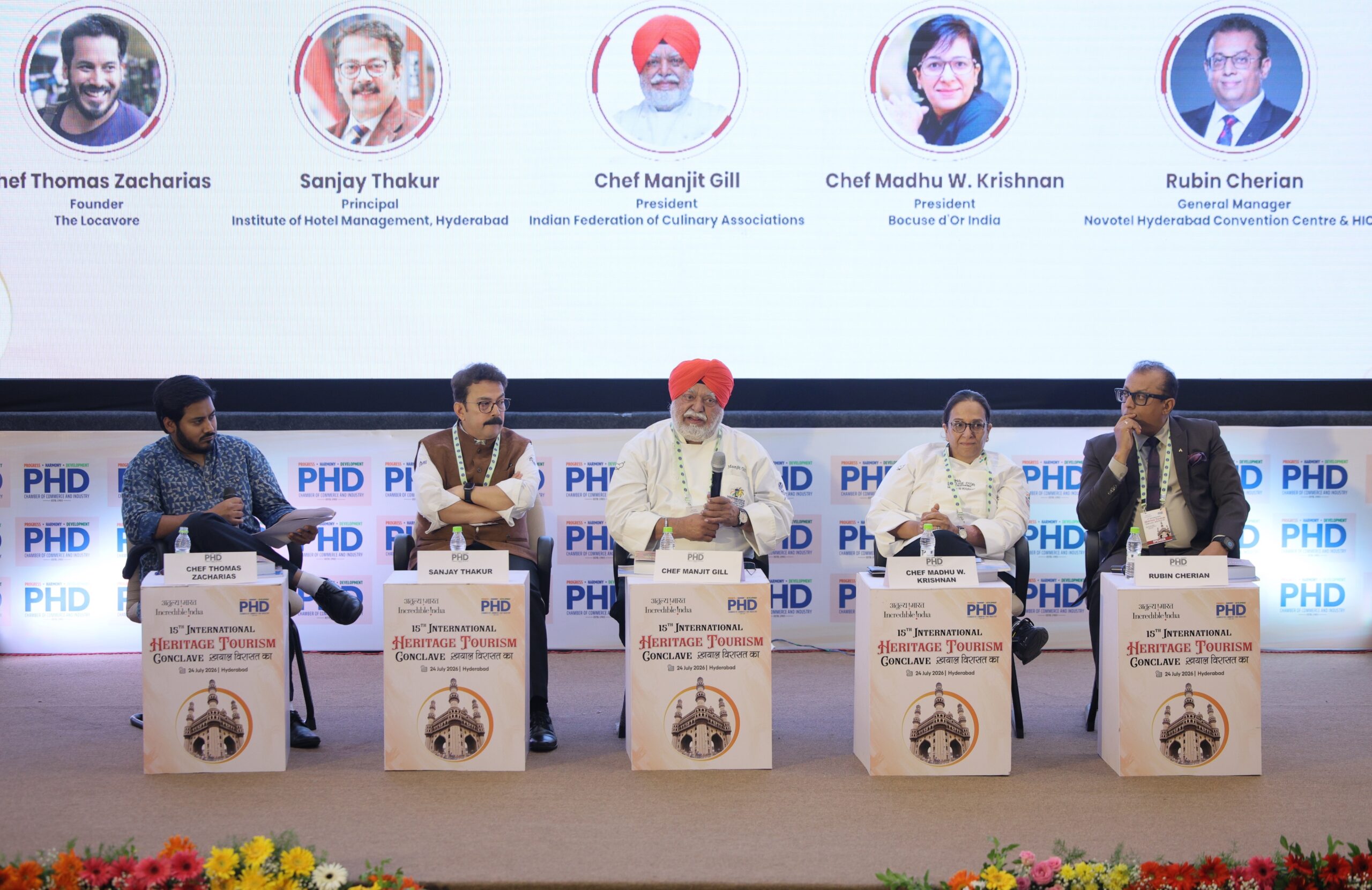
India’s culinary heritage can become one of the country’s strongest tourism assets, but only if it is documented, preserved and integrated into policy and hospitality education, industry leaders said at a panel discussion during the 15th International Heritage Tourism Conclave, organised by the PHD Chamber of Commerce and Industry (PHDCCI) at the Salar Jung Museum in Hyderabad.
The session, ‘Food as a Tourism Asset’, moderated by Chef Thomas Zacharias, Founder, The Locavore, brought together Chef Manjit Gill, President, Indian Federation of Culinary Associations (IFCA); Chef Madhu W. Krishnan, President, Bocuse d’Or India; Sanjay Thakur, Principal, Institute of Hotel Management (IHM), Hyderabad; and Rubin Cherian, General Manager, Novotel Hyderabad Convention Centre, to examine how India’s diverse food traditions can strengthen destination branding, heritage conservation and experience-led tourism.
Opening the discussion, Chef Zacharias observed that food is often the most enduring memory travellers take home from a destination. While monuments remain important, he said, travellers are increasingly planning journeys around local cuisines, indigenous food traditions, markets and regional culinary experiences.
He also noted that during his travels across the country, he repeatedly encountered concerns from traditional cooks and community elders that many recipes and food practices may disappear within a generation if they are not documented and passed on.
‘Food must be recognised as culture’
Calling for policy intervention, Chef Manjit Gill, President, IFCA, said India has failed to accord food the status it deserves as an element of cultural heritage.
“Food must be recognised as the culture and heritage of this country. Otherwise, these traditions will disappear, and we will all be responsible for that loss,” he said.
Gill argued that while global cuisines are systematically documented and taught in hospitality institutions, Indian regional cuisines continue to lack academic structure.
“We have learnt Western cuisine because it is taught as a subject. But where are the textbooks on Indian food? We have no tools to teach Indian cuisine and no structured books to read and study it.”
He stressed that preserving India’s culinary legacy cannot depend on individual efforts alone.
“One individual cannot do this. We can contribute our time and ideas, but somebody has to take ownership. Universities, institutions and the government must come together to create documentation and educational material so that future generations can learn India’s own culinary traditions.”
Gill urged policymakers to formally recognise culinary heritage within India’s cultural preservation framework.
Food creates lasting travel memories
Sharing his personal experiences, Chef Madhu W. Krishnan, President, Bocuse d’Or India, highlighted the emotional relationship between food and travel, saying culinary experiences often become the defining memory of a journey.
Recalling her childhood, she described waiting for his grandfather’s annual arrival from Kanpur carrying boxes filled with local sweets and savouries.
“Food became my first memory of travel.”
She also recalled family road trips where half the luggage space was intentionally left empty so fresh produce could be brought back home.
“Even today, I leave nearly half my suitcase empty whenever I travel because I know I will return with food. Food memories have always been linked with travel.”
According to Krishnan, destinations are remembered not only for their attractions but also for flavours that create emotional connections long after the journey ends.
Hospitality education must preserve regional cuisines
Responding to concerns about documentation, Sanjay Thakur, Principal,IHM Hyderabad, said hospitality institutions have a critical role in preserving indigenous culinary knowledge and are already taking steps in that direction.
While acknowledging Chef Gill’s concerns, Thakur said institutes under the National Council for Hotel Management have begun documenting Indian regional cuisines and developing educational resources.
“Institutions like IHM Hyderabad are trying to bridge this gap. Hospitality education has evolved significantly, and we are making efforts to preserve regional culinary knowledge through documentation and academic initiatives.”
He said future hospitality professionals should not only master international cuisines but also understand India’s traditional food systems, ingredients and regional culinary practices.
Food defines destination recall
Offering the hospitality industry’s perspective, Rubin Cherian, General Manager,Novotel Hyderabad Convention Centre, said memorable food experiences often become inseparable from travel itself.
Recalling a visit to Thailand, Cherian said one particular dessert continues to remind him of the entire journey.
“When I think of mango sticky rice, I immediately think about travelling to Thailand with my wife and friends. I remember the street food, shopping, experiences and everything associated with that trip.”
He said such experiences demonstrate the emotional role food plays in destination branding.
“Food literally connects people to their memories. When travellers remember a destination, they often remember what they ate as much as where they went.”
Food tourism offers new opportunities
The panellists agreed that culinary tourism presents significant opportunities for India’s hospitality and tourism sectors, particularly through curated food trails, regional storytelling, indigenous cuisines and community participation.
They emphasised that protecting traditional recipes, promoting local ingredients and documenting culinary practices can help diversify tourism offerings while creating economic opportunities for local communities.
The discussion concluded with a collective call for stronger collaboration among government agencies, hospitality institutions, chefs, tourism stakeholders and academia to preserve India’s culinary heritage.